Morocco has around 1,800 kilometres of Atlantic coastline and the overwhelming majority of visitors see one town of it. Essaouira is excellent and it is also a day trip from Marrakech, which is why it absorbs almost the entire coastal tourist load.
The rest of the coast is a genuinely different country: cold water, permanent wind, cliffs, lagoons, working fishing ports, and a string of bays where the only infrastructure is a café and a man renting boards.
Here it is, north to south.
Oualidia — the lagoon
Three hours north-west of Marrakech, and the anomaly on this coast: a tidal lagoon protected by a rock bar, which means calm, warm, swimmable water on a shoreline that is otherwise cold and violent.
It is Morocco's oyster capital — the beds are farmed in the lagoon and you eat them at plastic tables on the sand for a fraction of what they cost anywhere else. Birdlife is exceptional, with flamingos through the winter.
Who it suits: families, anyone who wants to actually swim, and people who like eating shellfish more than surfing.
Season: May to October for the water. Winter is for birds.
Essaouira — the wind
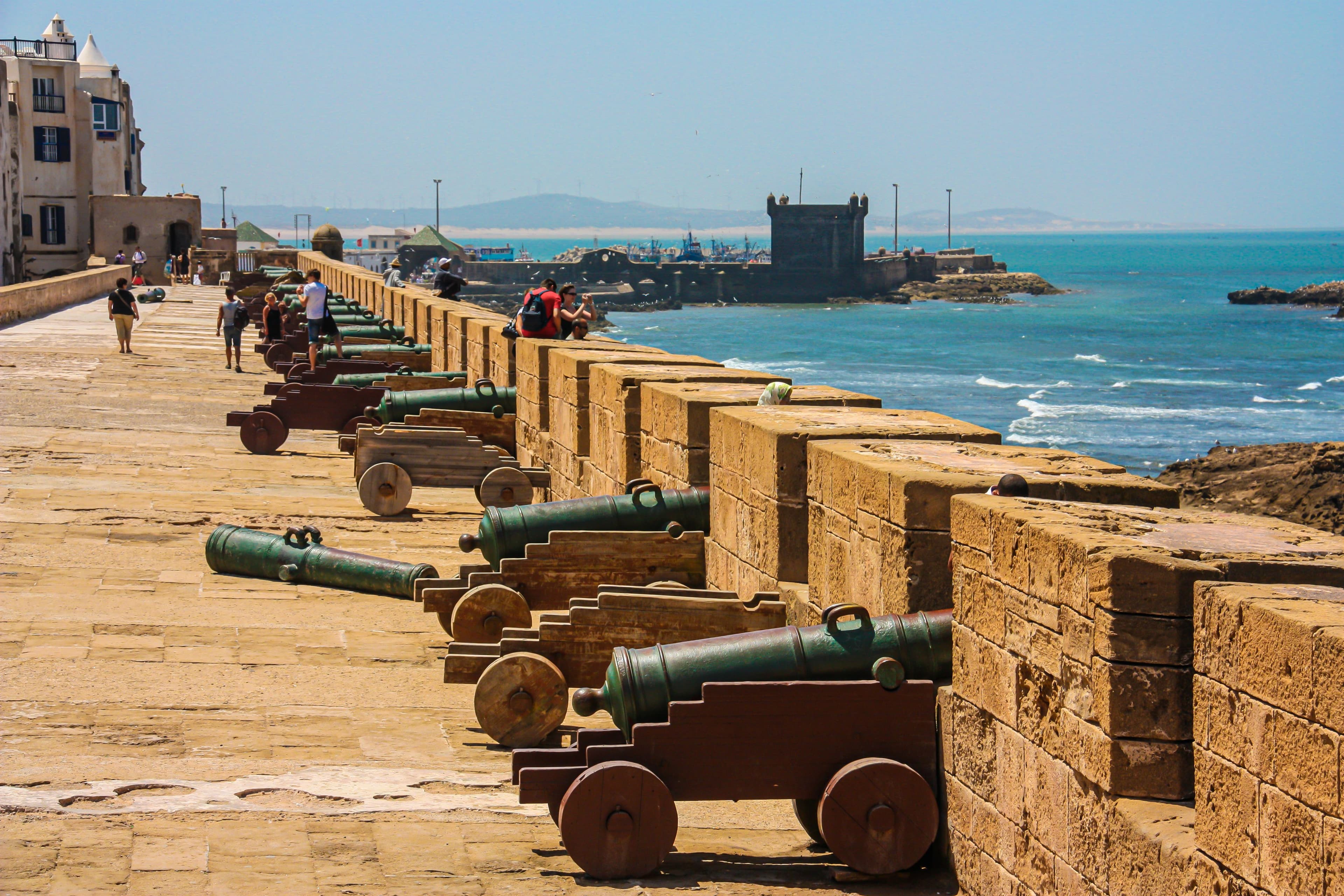
The one everyone knows, and it earns it. An eighteenth-century fortified port laid out by a French engineer for a Moroccan sultan, with ramparts, a working fishing fleet that still lands its catch on the quay, and a medina that is far easier to navigate than Marrakech's.
The defining feature is wind. The alizés blow hard and consistently from spring through summer, which is why Essaouira is a world kitesurfing and windsurfing destination and why it is also 15 °C cooler than Marrakech in August.
It also means it is often not a sunbathing beach. People arrive expecting a Mediterranean afternoon and find themselves in a gale.
Who it suits: everyone, briefly; kitesurfers and windsurfers, at length.
Don't miss: Sidi Kaouki, 25 km south — a wide empty beach with a marabout on the headland and a fraction of the people.
Taghazout and the Souss bays — the surf
Twenty kilometres north of Agadir, and the centre of Moroccan surfing. Taghazout was a fishing village, then a hippie stop, and is now a surf town proper — camps, schools, board rental, and a run of right-hand point breaks that work best from October to April when the North Atlantic swells arrive.
The named breaks, north to south: Anchor Point (the famous one, long and fast), Killer Point, La Source, Panorama, Hash Point, and Devil's Rock. Beginners go to Tamraght or Banana Beach; Anchor Point is not a learning wave.
Inland, Paradise Valley is a palm gorge with natural pools, thirty minutes up into the Anti-Atlas foothills, and the standard non-surfing day.
Who it suits: surfers of every level, and anyone who wants a warm, sociable base for a week rather than a moving itinerary.
Note: the water is cold. Atlantic Morocco runs 16–20 °C. You want a wetsuit, even in summer.
Mirleft and Sidi Ifni — the empty stretch
South of Agadir the coast road climbs onto cliffs and the tourism thins to almost nothing. This is our favourite stretch of the entire Moroccan coast.
Mirleft is a small town on a plateau above a series of cove beaches, with a laid-back scene and almost no development. Sidi Ifni was Spanish until 1969 and still looks it — Art Deco buildings in blue and white, a Spanish colonial grid, and a faded, salt-worn quality that is genuinely unlike anywhere else in Morocco.
Between them is Legzira, where the cliffs form vast natural arches over the beach. One of the two famous arches collapsed in 2016; the remaining one is still extraordinary, and the light on the red rock in late afternoon is the reason people drive four hours for it.
Who it suits: travellers who want the coast without the coast economy. Photographers. Anyone with a car and no fixed plan.
Dakhla — the far south
Twelve hundred kilometres south of Agadir, on a spit between the Atlantic and a forty-kilometre lagoon, and effectively a separate trip — it is a two-hour flight or a very long drive.
It is one of the best kitesurfing locations on earth: flat water, side-shore wind, almost every day of the year. The town itself is functional rather than pretty. People go for the lagoon.
Who it suits: kitesurfers, and nobody else in particular.
Asilah and the north
Between Tangier and Larache, and closer in feeling to Andalusia than to the south. Asilah is a whitewashed Portuguese-walled town whose medina walls are repainted with murals each summer for an arts festival. Larache has the Roman ruins of Lixus above it, largely unexcavated and almost unvisited.
Who it suits: anyone combining Morocco with southern Spain, or already going to Chefchaouen.
Practical
The water is cold, everywhere. The Canary Current runs down this coast and keeps it at 16–20 °C. This is why Morocco has surf and not beach resorts.
The wind is constant from Essaouira southwards, strongest from April to September. Excellent for sailing, tiring for lying down.
Getting around: the coast road from El Jadida to Agadir is straightforward driving and the best way to see it. South of Agadir toward Sidi Ifni it gets more spectacular and slower. CTM and Supratours run the main towns; below Mirleft you want a car.
Season: the coast is the summer answer to Morocco's heat — Essaouira at 24 °C while Marrakech hits 45. For surf, come in winter. For swimming, come to Oualidia in September.
The itinerary we would actually run
Five days, Marrakech loop: Essaouira two nights, Sidi Kaouki a day, then Taghazout two nights with a Paradise Valley day. Roughly six hours of total driving.
Ten days, the full southern coast: as above, then Mirleft, Legzira, Sidi Ifni, and back inland through the Anti-Atlas and Tafraoute. This is one of the best road trips in the country and almost nobody does it.