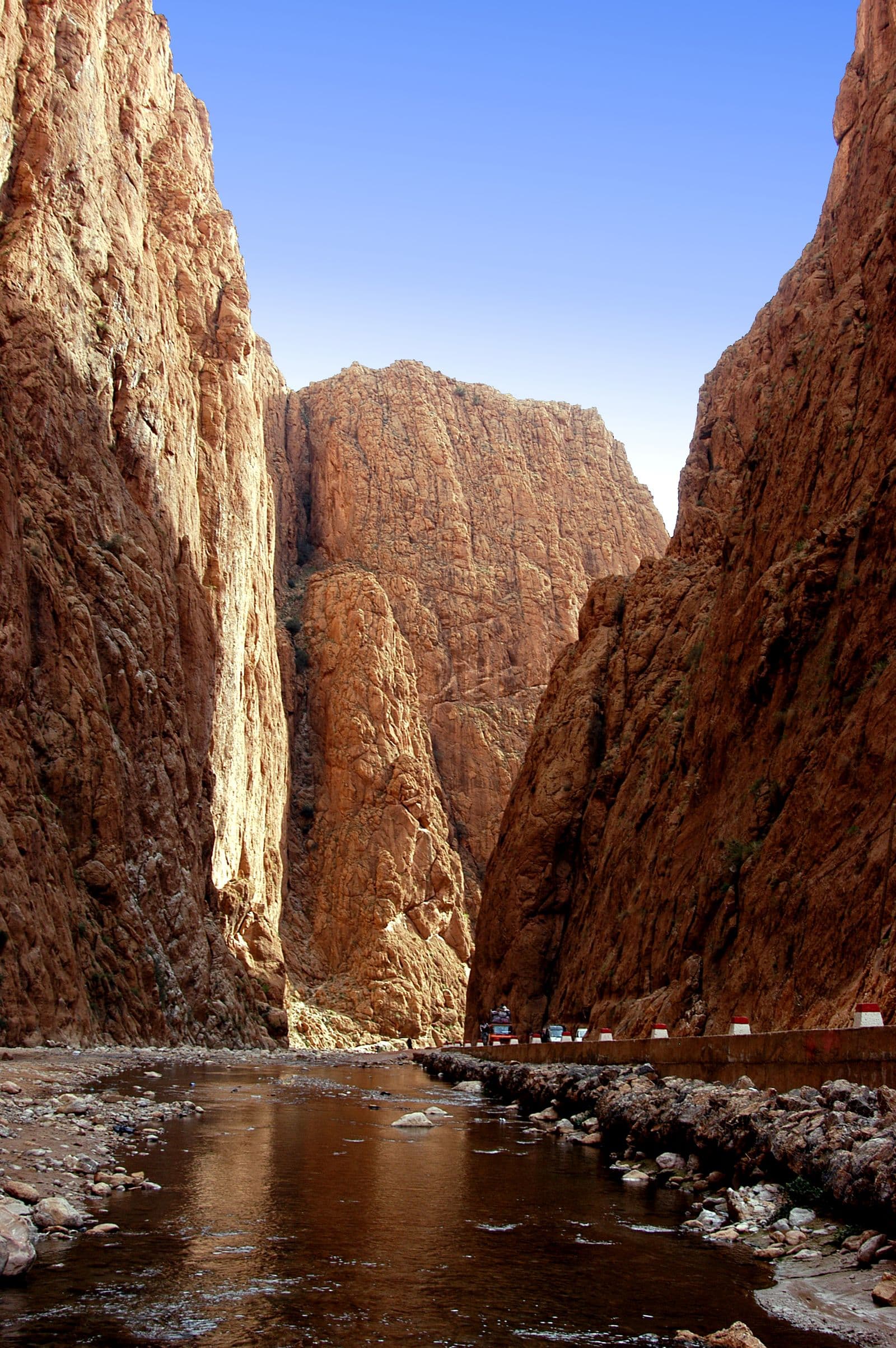
Tafraout means basin in Tachelhit, and the name is a description rather than a flourish. The town sits in a bowl of pink granite in the Anti-Atlas, ringed by boulders the size of houses, at the point where the Ameln valley opens out.
It is worth more than a photo stop, and almost every itinerary treats it as one.
The rock, which is very old
The Anti-Atlas is the oldest mountain range in Morocco by a long way. These are Precambrian rocks — the granite around Tafraoute was intruded, uplifted and then weathered over a timescale that makes the High Atlas look like scaffolding still going up.
That age is why the landscape looks the way it does. Nothing here is sharp. The granite has weathered into rounded domes and stacked boulders, split along joint lines into shapes that look deliberately balanced. The rock genuinely is pink — feldspar, not a trick of the light — though it turns properly red for about twenty minutes after sunrise and again before sunset.
Above the valley, Jebel L'Kest rises to 2,359 metres. It is a different rock again: quartzite, harder and greyer, forming a long ridge that catches the light differently from the granite below it. Walkers call it the amethyst mountain.
The painted rocks
In 1984 the Belgian artist Jean Vérame painted a group of boulders south of town blue, with help from local firefighters and a great deal of paint. They have faded and been retouched since.
Opinion in Tafraoute is divided between mild pride and mild bafflement, which is about the correct response. Go for the walk out rather than the artwork: the approach crosses a landscape strange enough that the paint is not the strangest thing in it.
The valley that feeds it
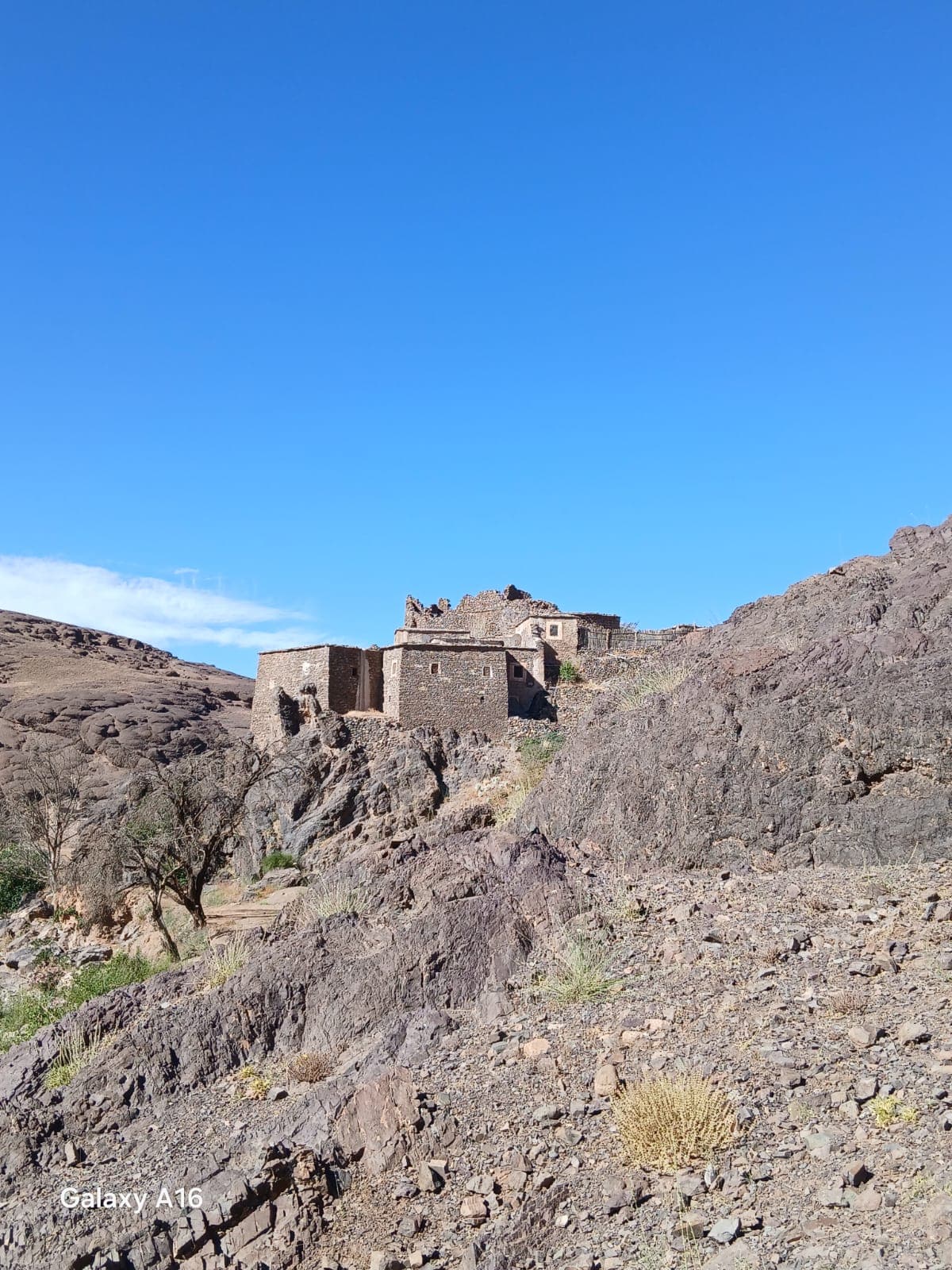
The Ameln valley runs east–west below Jebel L'Kest, and it is the reason anyone settled here. Some two dozen villages sit along the north side, built where the mountain meets the cultivable ground — never on the flat, because flat land is too valuable to build on.
The terraces carry almonds, argan and figs. Almond is the cash crop and the identity: the trees flower in late February, all at once, across the whole valley, and the sight of white and pink blossom against red granite is the reason a small number of people plan an entire trip around a two-week window.
The Almond Blossom Festival — Amerzgane n'Louz — usually falls in the second week of February, with music, dancing and a great deal of amlou. It is a real agricultural festival that happens to have visitors, not a performance staged for them.
Amlou is the local product worth carrying home: argan oil, roasted almonds and honey ground into a thick spread. Tafraoute eats it at breakfast with bread.
The history, briefly and honestly
This region was among the very last in Morocco to come under French control, and that fact still shapes how people here talk about themselves.
The Protectorate was declared in 1912, but the western Anti-Atlas was not pacified for another twenty-two years. The French campaign against the Anti-Atlas tribes ran through 1933 and into 1934, and it ended in March 1934 with the surrender of Abdallah Zakour, who led the resistance in the western Anti-Atlas, after a three-day battle at Aït Abdallah in which the French used aircraft and artillery against a position that ran out of ammunition.
That was effectively the end of the "pacification of Morocco." Not Fez, not Marrakech, not the Rif — a valley in the Anti-Atlas, in 1934, twenty-two years after the Protectorate began on paper.
To the southwest, the Spanish enclave of Ifni was a separate story again: Spain landed at Sidi Ifni in 1934 and held it until it was returned to Morocco by treaty in 1969. Sidi Ifni still looks Spanish, and it is two hours from here.
Why the town is richer than it should be
Here is the thing that explains Tafraoute better than the geology does.
The valley is beautiful and agriculturally marginal. Rain is unreliable, the terraces are small, and the twentieth century brought repeated drought. So people left — first to Casablanca and the coastal cities, later to France and Belgium.
They left in a particular way. Men of the Ameln went into grocery and retail, and they were extremely good at it. A large share of the neighbourhood grocers in Casablanca, Rabat and Marrakech — and a great many of the Moroccan-run shops in France — trace back to this one valley. Épicier and soussi became near-synonyms in Moroccan French.
And then they sent the money home, and kept sending it. Which is why a remote mountain village has substantial houses, a functioning water supply, a mosque in good repair, and streets that are visibly better maintained than the region's economy would predict. The money was not earned here. It was earned in cities and spent here, deliberately, over three generations.
You can see this in the buildings. A large modern villa standing empty for eleven months of the year is not a mystery: its owner works in Casablanca or Lyon and comes back in August, and the house is both a home and a statement that the family did not lose its place in the valley.
The other thing to understand
The people here are Ishelhin — Amazigh, speaking Tachelhit, which is the southern of Morocco's three main Amazigh languages. Not Arabic, and not the Tamazight of the Middle Atlas.
Since 2011 Tamazight has been an official language of Morocco alongside Arabic, and Tifinagh script now appears on public signage. In practice the everyday language of the Ameln valley is Tachelhit, French is common among returning emigrants, and Arabic is the language of school and administration. A few words of Tachelhit — azul for hello, tanemmirt for thank you — are noticed here more than almost anywhere else in Morocco.
Getting there and staying
Agadir is the nearest airport, about three hours by road. From Marrakech it is a full day, and the drive south through the Anti-Atlas is the good part.
A hire car is close to essential. Buses connect the larger towns, but the point of Tafraoute is the valley and the valley has no bus.
The road south toward Tiznit through the Aït Mansour gorge — palm-floored, narrow, almost empty — is one of the best drives in Morocco and the reason to allow an extra day.
When: October to April. February for the blossom. Summer here is punishing and the sensible visitor goes to the High Atlas instead.
How long: two nights minimum. One night means you drove a long way to photograph a boulder. Three lets you walk up toward Jebel L'Kest, spend a morning in the Ameln villages, and drive the gorge.
Why we send people here
Because it is a place with no headline sight, and that turns out to be a feature. There is no Toubkal, no Erg Chebbi, no Jemaa el-Fna — nothing that has to be queued for or ticked off. What there is instead is an inhabited landscape of extraordinary rock, a valley that has been farmed for centuries by people who also happen to run half the grocery shops in the country, and a history that ended later and more stubbornly than the standard account of Morocco admits.
Come in February if you can. Come at all, is the better advice.