Most people do not know Morocco has skiing. The ones who do usually picture Oukaimeden — a small resort with a handful of lifts an hour from Marrakech — and stop there. That is not the interesting part.
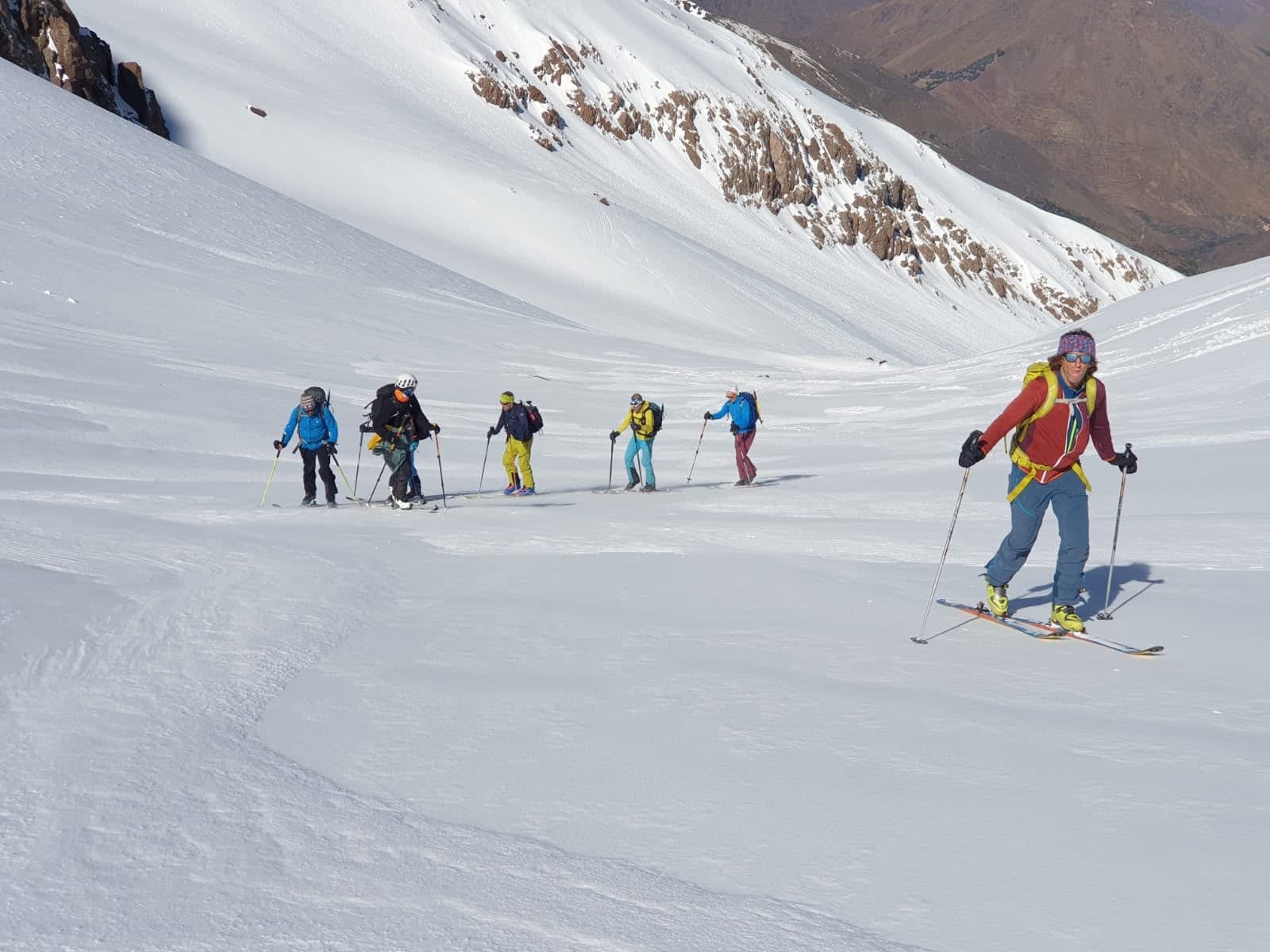
The interesting part is that the High Atlas holds a long chain of 3,500 to 4,167-metre peaks that fill with snow between January and April, with almost no one on them, three hours from a European flight. You skin up from a valley where walnut trees are budding, and four hours later you are clicking in at 4,000 metres looking south at a haze that is the edge of the Sahara.
We run these trips on skis and on splitboards. Everything below applies to both, with the splitboard-specific notes flagged where they matter.
Why here rather than the Alps
Nobody is on it. On a good day off the Toubkal massif you will see your own group and possibly one other. There are no lifts, no queues, no tracked-out powder by ten in the morning.
The vertical is real. From the Neltner refuge at 3,207 m you can access descents of 800 to 1,200 metres. The Toubkal summit itself gives roughly 1,000 metres of continuous fall line back to the refuge.
It is cheap. A week of guided touring in Morocco costs a fraction of the equivalent in Chamonix, and the flights are shorter than most people expect — three and a half hours from London or Paris.
The contrast. You finish a touring week, drive ninety minutes, and eat dinner in Marrakech. Nowhere else offers a 4,000-metre ski descent and a medina in the same day.
What you give up: reliability. Which brings us to the honest part.
The season, honestly
January to early April, with February and March the dependable core.
Snow in the High Atlas is variable in a way alpine skiers find unfamiliar. Some winters deliver metres and the touring is world-class from Christmas. Others are thin, and the snowline sits above 3,000 m, meaning a walk in boots before you can put skis on.
This is the single most important thing to understand before booking: Moroccan touring is condition-dependent in a way that requires flexibility. We plan routes on the week, not months ahead. Anyone selling you a fixed itinerary in December for March is selling you a plan they will have to change.
The upside of a thin year is that Oukaimeden and the lower objectives still work, and the weather is often superb — high pressure, cold nights, blue days.
The routes
Toubkal, 4,167 m
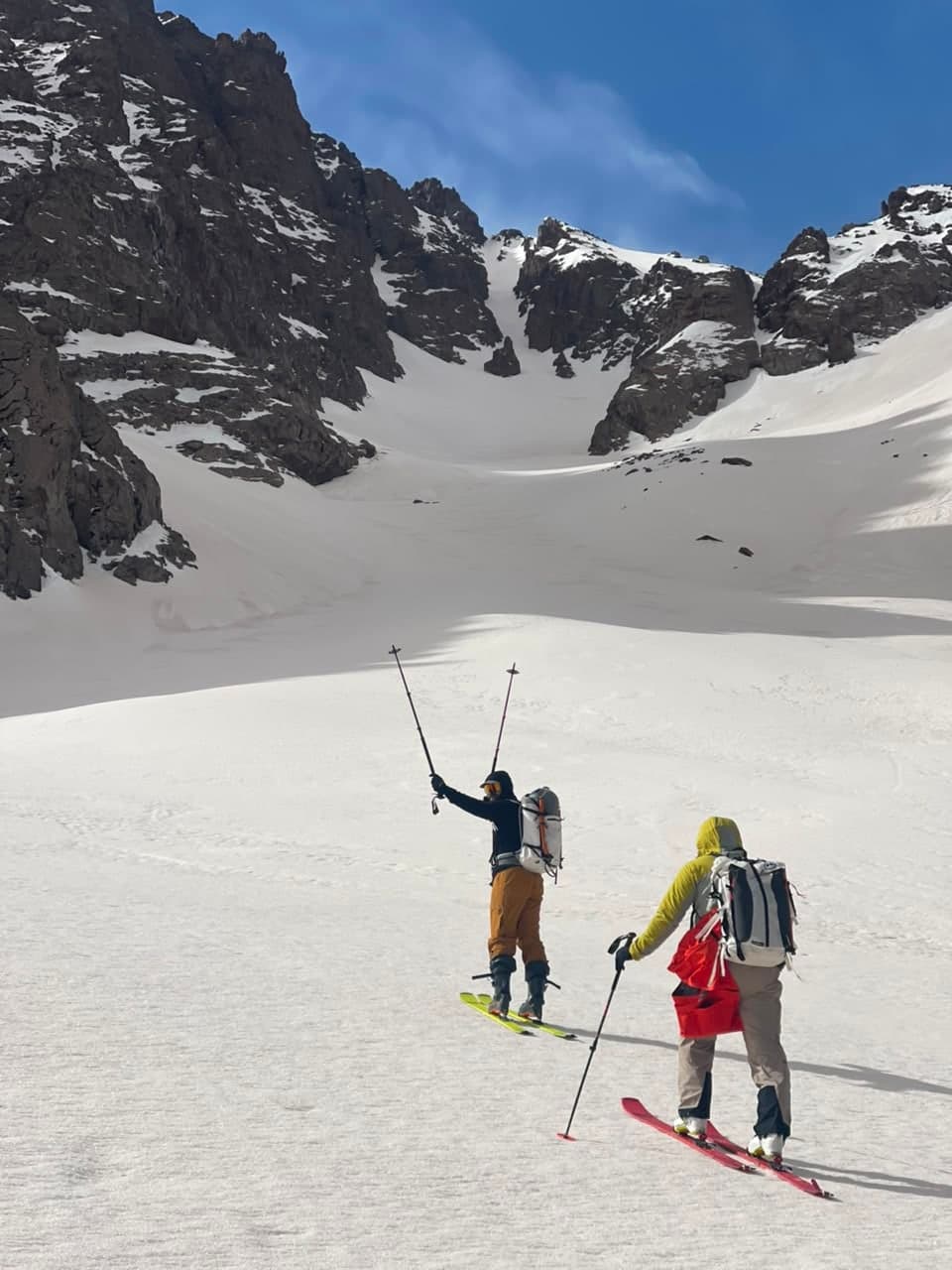
The obvious objective and a genuinely good ski descent. Skin from Imlil or the Sidi Chamharouch shrine to the Neltner refuge, sleep, then climb the south cwm on skins with a bootpack near the top.
The descent runs about 1,000 vertical metres. In good spring snow it is superb; in hard early-season conditions it is a serious outing where ski crampons earn their place.
Time: 3 days minimum from Marrakech. Better as part of a week.
Ouanoukrim and Timesguida, 4,089 m
Toubkal's neighbours, and by most accounts the better skiing. Wider bowls, more consistent angle, and reachable from the same refuge. If the Toubkal cwm is wind-scoured — which it often is — this is where the snow will be.
Angour, 3,616 m
Above Oukaimeden, and the standard acclimatisation objective. A broad plateau with north-facing bowls dropping off the far side, reachable in a morning. You can use the resort lift for the first few hundred metres, which makes it an efficient first day.
Tazaghart plateau, 3,980 m
A big flat-topped massif west of Toubkal with steep couloirs off its rim. This is the freeride objective — for strong skiers only, and requiring real avalanche judgement.
The Toubkal ski traverse
Four to six days linking refuges and village gîtes across the massif, skiing a summit most days. This is the trip to do if you have a week, and it is the closest thing Morocco has to a Haute Route.
Splitboarding here
Everything above works on a splitboard, with three practical notes:
Flat sections. Some approaches — particularly the valley out of Imlil and the Oukaimeden plateau — involve long, near-flat traverses that skiers glide and splitboarders do not. Poles are not optional.
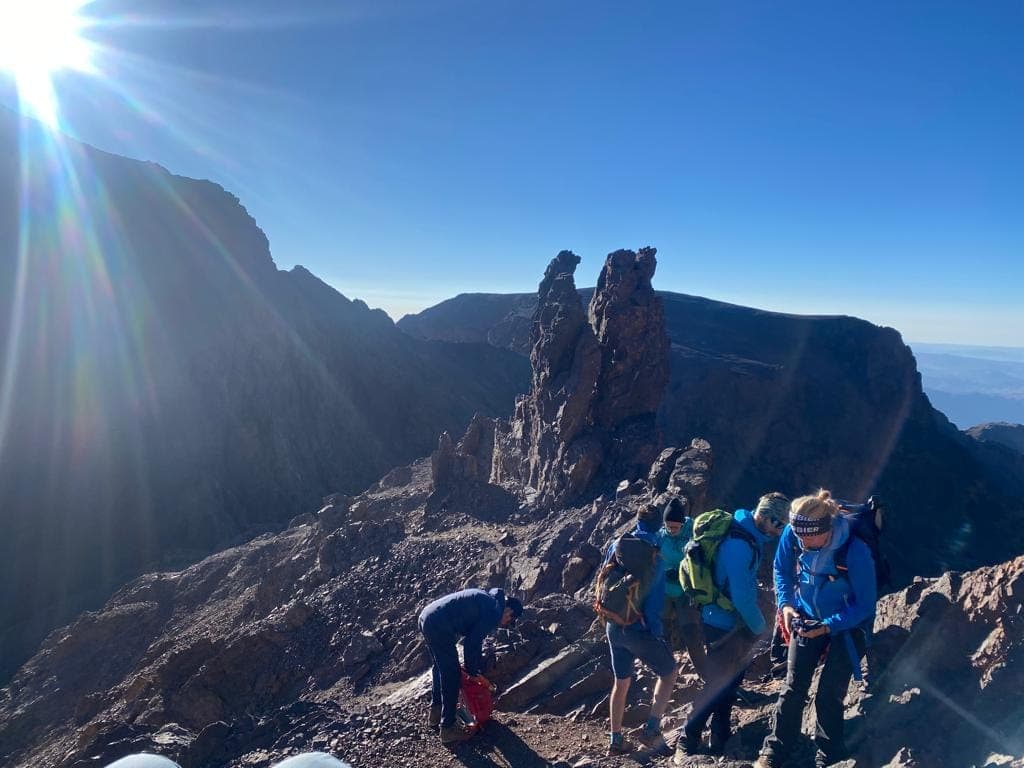
Bootpacking. The final sections of Toubkal and most couloir entries are climbed on foot. A board on your back in wind is worse than skis; plan for it.
Kit availability. Ski touring gear can be rented in Imlil and Oukaimeden. Splitboard gear essentially cannot. Bring your own, including skins cut for your board and a spare set of pucks and hardware.
Avalanche reality
Take this seriously. The High Atlas has genuine avalanche terrain and no forecasting service. There is no equivalent of the Météo-France or SLF bulletin. You are assessing the snowpack yourself, or trusting a guide who is.
The typical hazards here:
- Wind slab. The dominant problem. The Atlas is a windy range and lee slopes load fast and hard.
- Rapid warming. Latitude 31° means intense sun. A north face in the morning and the same face at two in the afternoon are different snowpacks.
- A thin, faceted early-season base. Long cold clear spells between storms build weak layers.
Carry a transceiver, probe and shovel, and know how to use them. Rescue is not helicopter-quick here; the practical reality is that your party is the rescue.
This is the strongest argument for a guide in Moroccan touring, well beyond the legal requirement in the Toubkal park.
What to bring
Touring kit:
- Skis or splitboard with skins; ski crampons (used more here than in the Alps, because refrozen spring snow is the normal morning condition)
- Boot crampons and an ice axe for the summit sections
- Transceiver, probe, shovel
- Helmet
Clothing: the same layers as any alpine touring week, plus more sun protection than instinct suggests. Factor 50, a stick for lips and nose, category 4 glacier glasses. At 4,000 m in North African sun, on snow, exposure is severe.
Also: a headtorch (alpine starts), 1.5 litres of water minimum, and cash — refuges and gîtes are cash only.
Where you sleep
Refuge du Toubkal (Neltner), 3,207 m — two buildings, dormitories, meals provided, and the base for everything on the massif.
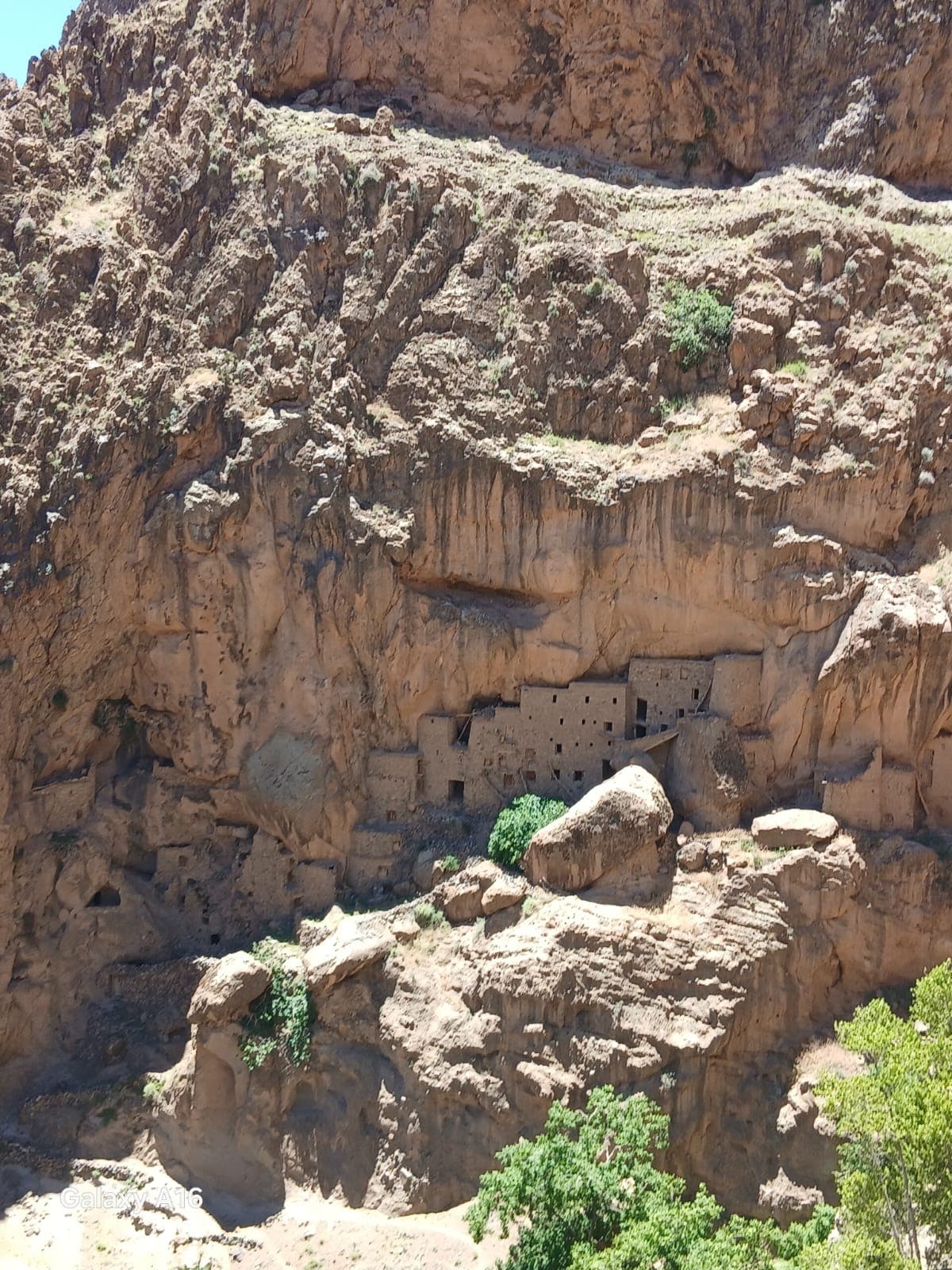
Village gîtes in Imlil, Aroumd and Tacheddirt — simple, warm, family-run, and the best food of the trip.
Oukaimeden — a handful of hotels and a CAF refuge, at 2,600 m, which makes it useful for acclimatisation as well as convenience.
Nothing is luxurious. Everything is warm, fed and adequate.
Getting there
Fly to Marrakech Menara. Imlil is 90 minutes by road; Oukaimeden is about the same. There is no need for an internal flight, a long transfer, or an early start — you can land in the morning and be skinning after lunch.
Who it suits
Yes: confident off-piste skiers or splitboarders comfortable with a full day of skinning, 800–1,200 m of ascent, and descents in variable snow. Previous touring experience matters more than technical descending ability.
Not yet: anyone who has only skied pistes. The snow here is rarely groomed perfection — it is wind-affected, sun-crusted, and occasionally superb.
Fitness: four to six hours of ascent, at altitude. The altitude is the part people underestimate; 4,000 m is 4,000 m regardless of latitude.
The case for it
Morocco is not a replacement for the Alps and does not try to be. It is a different proposition: emptier, cheaper, more variable, and considerably stranger. Skiing a 4,000-metre peak in the morning and drinking mint tea on a rooftop in Marrakech that evening is not an experience available anywhere else, and the mountains themselves are far better than their reputation.
Come in February or March, come flexible about the objective, and bring your own splitboard if that is what you ride.