The word Berber comes from the same root as barbarian — it is what outsiders called them. The people call themselves Amazigh (plural Imazighen), meaning roughly "free people," and the language is Tamazight, which since 2011 has been an official language of Morocco alongside Arabic. Using the right word costs nothing and is noticed.
Most Atlas trekking passes through Amazigh villages, and many itineraries include a tea stop or a night in a family house. What follows is what makes that go well.
Hospitality is an obligation, not a service
This is the thing most worth understanding. In rural Moroccan custom, a guest imposes a duty on the household — to feed, to shelter, to protect. It is not optional and it is not conditional on the guest's ability to pay. A family with very little will still produce tea, bread, oil and whatever else exists.
The failure mode for visitors is to treat this as included in a tour price and consume it accordingly. The alternative is to receive it as what it is: a real cost borne by real people, offered because the custom requires it.
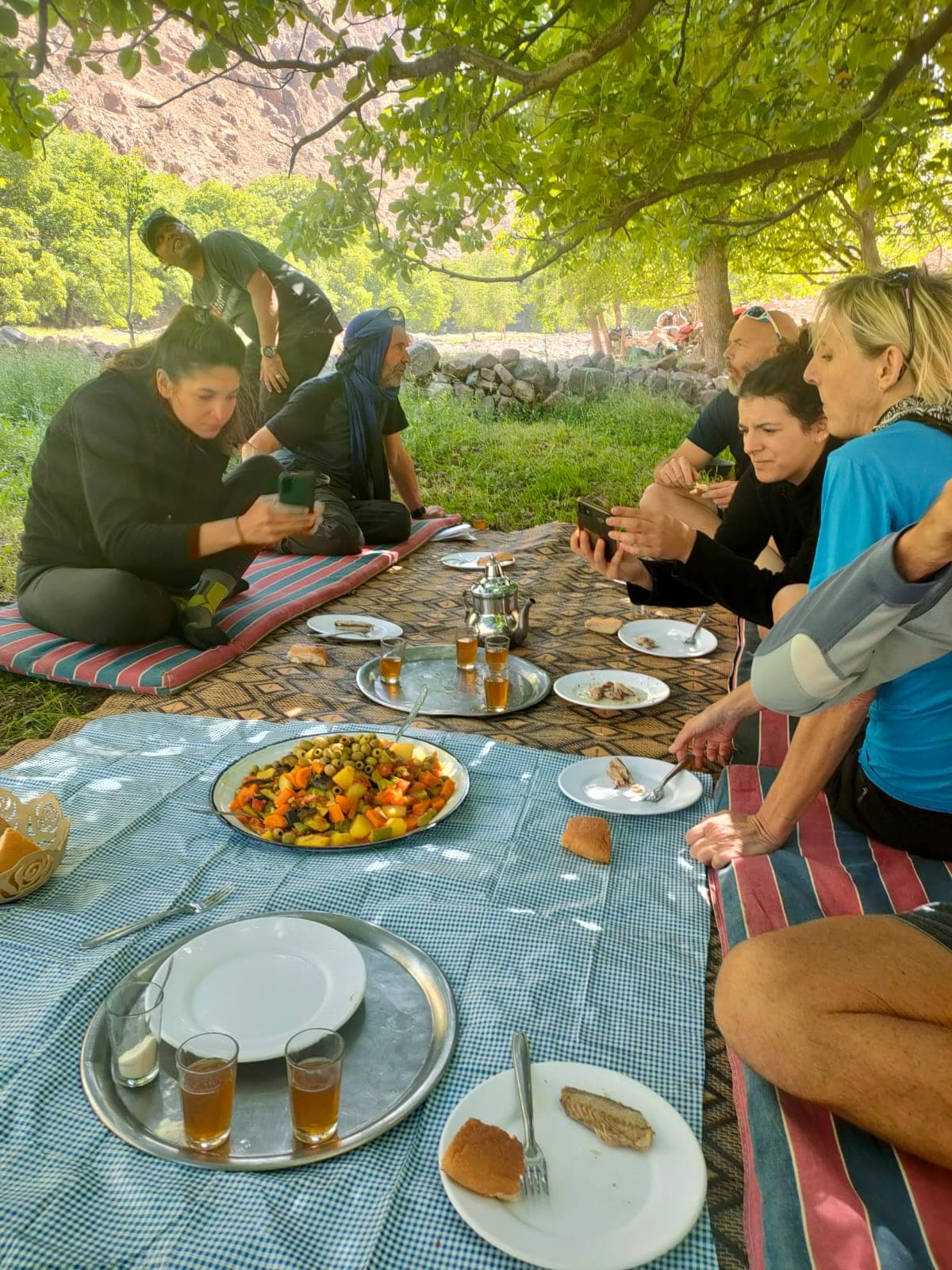
Accept the tea. Accepting is the polite move; declining reads as refusing the relationship. Three glasses is traditional and there is no obligation to finish the third.
Photographs
Ask. Every time, and especially of women.
This is not a formality. Rural Moroccan norms around photographing women are genuinely conservative, and a camera pointed at someone's wife or daughter without permission is an offence in a way that has nothing to do with tourism. A guide can ask on your behalf, and the answer is sometimes no.
Children will usually say yes enthusiastically and then ask for money or sweets, which brings us to the next thing.
Do not give things to children
It feels generous. It is corrosive.
Handing out pens, sweets and coins to children on a trail teaches a straightforward lesson: that approaching foreigners produces goods. Over a few seasons that becomes a village where children skip school to work the path, and where the relationship between residents and visitors is transactional from the first moment.
If you want to contribute, give to the school, the association, or the household hosting you — through your guide, who knows what is actually needed. It is less satisfying and considerably more useful.
Clothes
Cover shoulders and knees, both sexes. In the mountains this is practical anyway — sun and cold — and it removes the single most common source of quiet friction.
Women do not need to cover their hair in village settings. In a working mosque that changes, but non-Muslims are generally not admitted to Moroccan mosques in any case.
Things you will see and might misread
Separate rooms and separate eating. Men and women in traditional households often socialise separately. A woman visitor may be invited into the women's space, which is a compliment and worth accepting. A male visitor generally will not be, and should not push.
Refusal of payment. A host may refuse money firmly and repeatedly. Pushing cash into someone's hand after they have declined it three times converts hospitality into a transaction and can genuinely insult them. Ask your guide what is appropriate — often a gift for the household, or payment routed through the guide, is the form that works.
Shoes off. At the threshold of the living space, always.
Language
A few words go an unreasonable distance.
- Azul — hello (Tamazight)
- Tanemmirt — thank you (Tamazight)
- Salam / Shukran — hello / thank you (Arabic, understood everywhere)
- La bas? — "everything alright?", the universal greeting
Pronouncing them badly is fine. The attempt is the message.
The honest caveat
A village visit arranged as a scheduled stop on a commercial itinerary is a different thing from being genuinely hosted, and it is worth being clear-eyed about which you have. Neither is bad. But if a house receives four groups a week by arrangement, the tea is a service and should be paid for as one — and the warmth you experience is professional courtesy, which is also real, just different.
The trips where this works best are the longer walking ones, where you arrive on foot, tired, in the evening, and the arrangement is between your guide and someone he grew up with.