You will be offered mint tea within about four hours of arriving in Morocco, and then repeatedly, in shops, in houses, at the roadside, in the middle of a negotiation you were not aware you had entered. Understanding what the gesture means — and what it does not — saves a lot of confusion.
It is not ancient
The thing most guidebooks imply and almost nobody states: mint tea arrived in Morocco in the nineteenth century. Green gunpowder tea came through trade with Britain — one account credits British merchants redirecting stock blocked from Baltic markets during the Crimean War — and Morocco took to it comprehensively.
Within a couple of generations it had absorbed the existing hospitality culture, which had run on other infusions, and become the national drink. So it is a genuine tradition that is also a fairly recent one, and the mint and the sugar are the Moroccan contribution to a Chinese leaf.
What is in the glass
Gunpowder green tea, rolled into pellets — this is the base and it is deliberately strong.
Spearmint, a great deal of it, fresh, stuffed into the pot as a bundle rather than a few leaves. In winter, or in the mountains where mint is scarce, you will get wormwood (chiba), which is bitter and medicinal, or verbena, or sage.
Sugar, in quantity, traditionally broken off a cone with a small hammer. The sugar is not a corruption; it is structural to the drink as Moroccans make it.
The first infusion is often poured off and discarded — it carries the bitterness. The pot is then refilled and returned to the heat, and the tea is poured, returned to the pot, and poured again to mix it, because you cannot stir a pot full of mint.
Why it is poured from height
Two reasons, and they are both real.
Aeration. The long pour oxygenates the tea and creates the foam — the keskes — on the surface of the glass. A glass poured without foam is considered badly made, and a host will pour it back and do it again.
Display. It is a skill, performed in front of the guest, and doing it well is a form of respect. Watching someone pour from forty centimetres into a small glass without spilling is part of what you are being given.
The three glasses
There is a Maghrebi saying, usually attributed to a Tuareg formulation, that the three glasses served in sequence are:
The first is bitter as life, the second sweet as love, the third gentle as death.
Each pour comes from the same pot, so the tea genuinely does change — the leaves have been steeping longer, the sugar distributes differently, the mint softens. Whether or not any given household recites the saying, the three-glass structure is real, and leaving after one can read as leaving early.
What accepting does and does not mean
This is the practical part, and it matters most in the souk.
In a shop: you will be brought tea before the carpets come out. It is hospitality and it is also, transparently, commercial technique — the two are not separable in Moroccan trade and no shopkeeper thinks they are.
Accepting the tea does not oblige you to buy anything. This is genuinely true and worth internalising, because a great deal of tourist over-spending comes from people who felt they had incurred a debt. You may drink all three glasses, thank the shopkeeper warmly, say the carpets are beautiful and that you are not buying today, and leave. This happens constantly and nobody is offended.
In a home: entirely different. Here it is not commercial at all, and refusing outright is genuinely rude. If you cannot drink it, take the glass, hold it, sip once. The gesture is in the accepting.
If you do not want sugar
Ask. Bla sukkar — without sugar — or shwiya sukkar, a little sugar. It is a normal request, particularly in cities, and no one takes offence. The tea underneath is good and most visitors find they prefer it once they have tried it unsweetened.
In a village house, where the sugar is a sign that the host is spending on you, it is kinder to drink it as served.
Small points of manners
- Tea is served and received with the right hand.
- The host pours; a guest does not usually serve themselves.
- The glass is small and gets refilled. Emptying it is a request for more; leaving a little at the bottom of the third is a gentle signal you are finished.
- The foam matters. If you are ever the one pouring, pour high.
- It is drunk hot, in hot weather, on purpose — the theory being that it makes you sweat and therefore cools you. Whether or not the physiology holds, the habit is universal.
Where to drink it
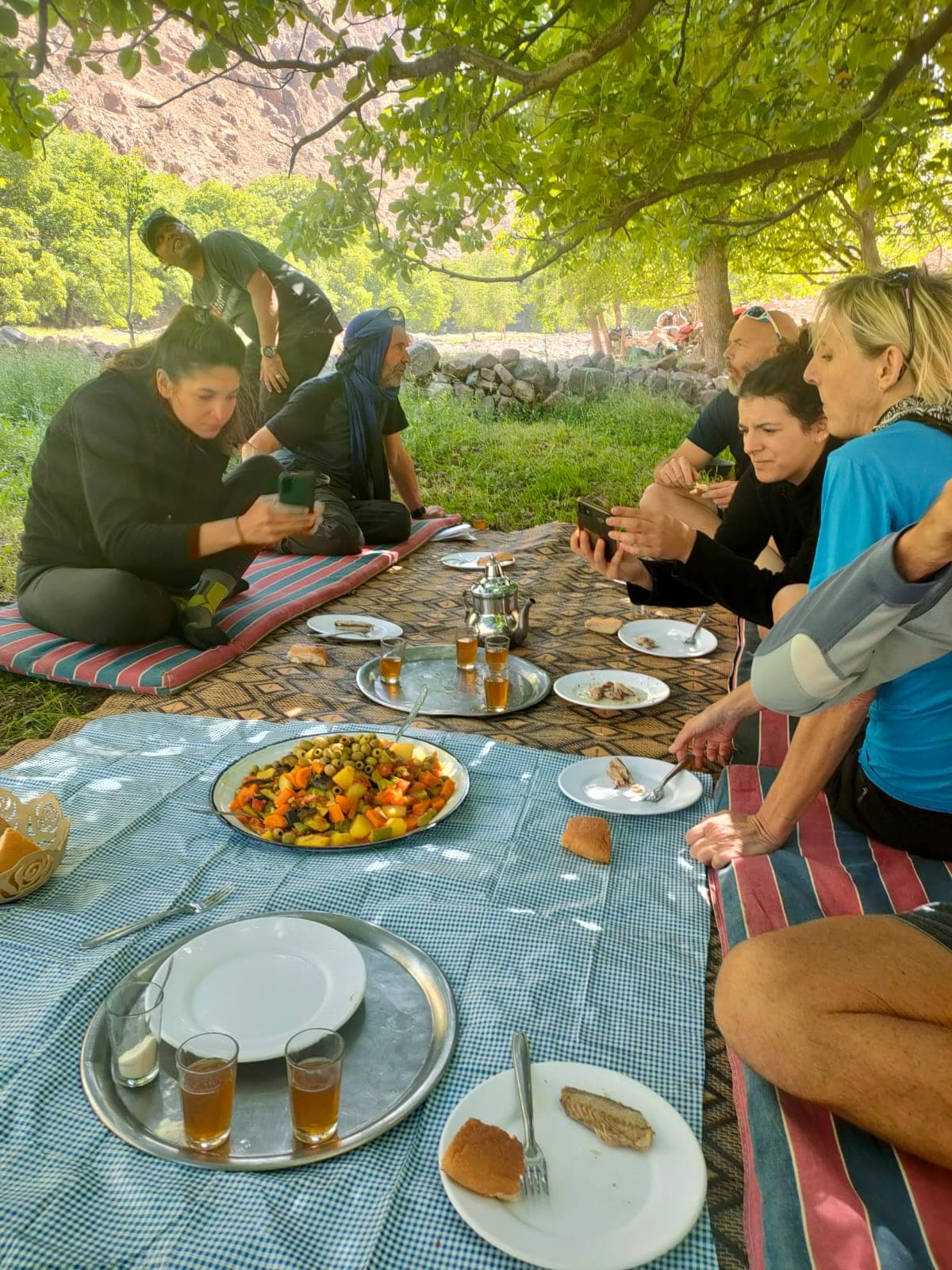
Anywhere, is the honest answer, but a few are worth going out of your way for: a rooftop in the medina at the hour when the light goes orange; the terrace of a mountain gîte after a day's walking, when the sugar is genuinely medicinal; and a Saharan bivouac after dinner, poured over a fire, by someone who has made it several thousand times.
That last one is the version that converts people who thought they did not like sweet tea.