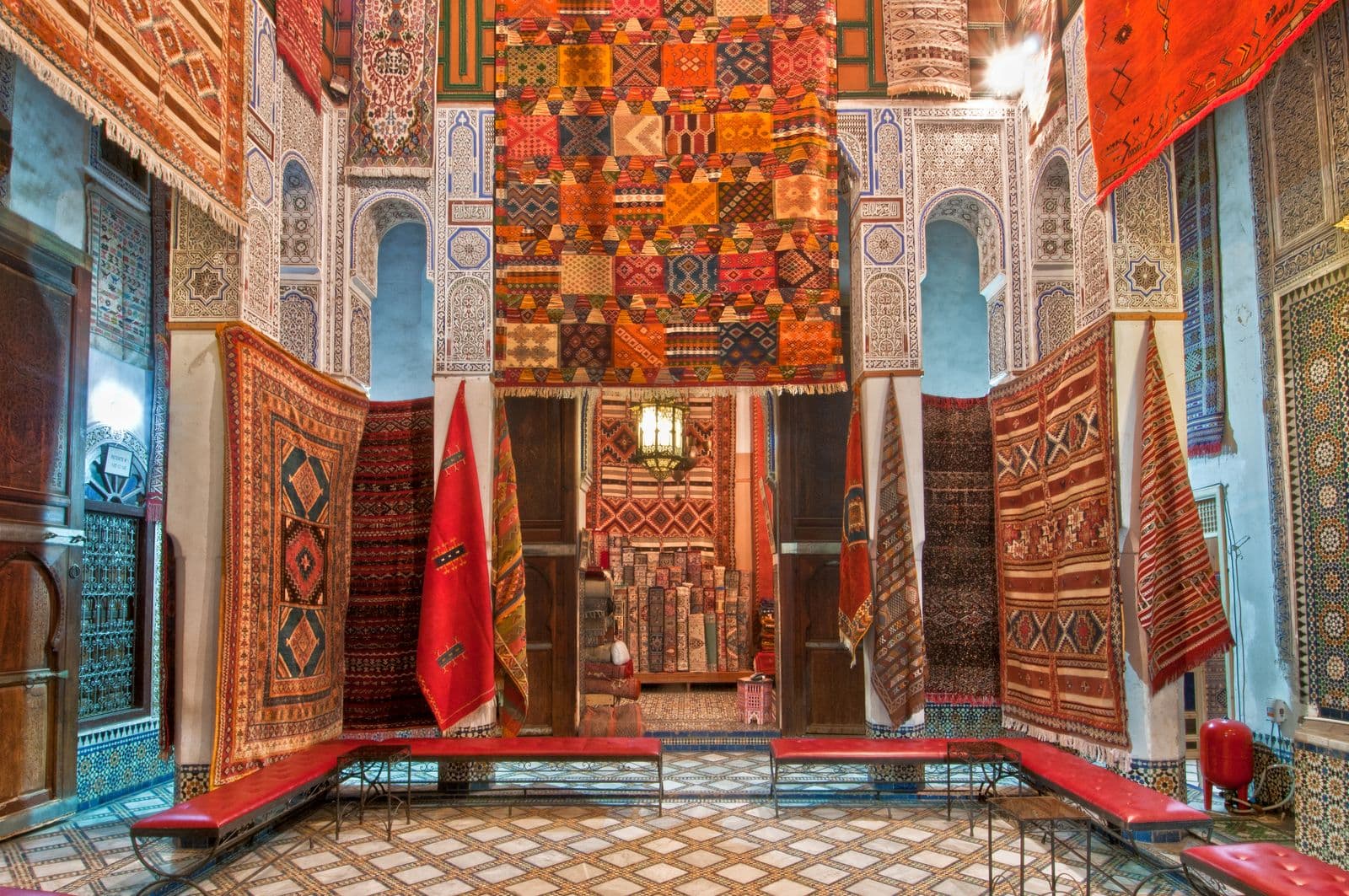
Ask a dealer what the pattern means and you will usually get a story invented for the occasion. Ask the woman who wove it, if you ever get the chance, and you will get something much more specific.
A language without an alphabet
Amazigh symbols are not decoration that happens to look meaningful. Many derive from Tifinagh, among the oldest writing systems still in use, and the shapes carry consistent meanings across enormous distances:
- Zigzag — water, and by extension the flow of life.
- Diamond — protection, specifically against the evil eye.
- Triangle — woman, fertility, shelter.
- The eye — a talisman, worked in where a household felt exposed.
Most carpets were woven by women, and most of the vocabulary concerns fertility, motherhood and the protection of a house. That is not a coincidence — it is the subject matter of the people doing the work.
These patterns were a form of prayer made physical, passed down through generations of women without a written alphabet, encoded instead in wool, geometry, and the slow rhythm of the loom.
Reading one
Look at the field before the border. A carpet with a dense, repeating diamond field is usually protective in intent. A carpet with long, uninterrupted zigzags running the length of the piece is usually about water — often literally, made in a place where water was scarce and the weaver's daily walk was long.
Irregularity is a good sign. A pattern that breaks and resumes slightly out of step means a person made a decision at that row, not that a machine did.
Buying honestly
Old and hand-woven costs what it costs. If a piece is very cheap and very regular, it is neither.
Ask where it was made rather than what it means; the region tells you more, and it is a question with a real answer. Fixed-price cooperatives exist in most of the Middle Atlas towns and pay the weavers directly — the price is higher and the proportion reaching the maker is much higher still.