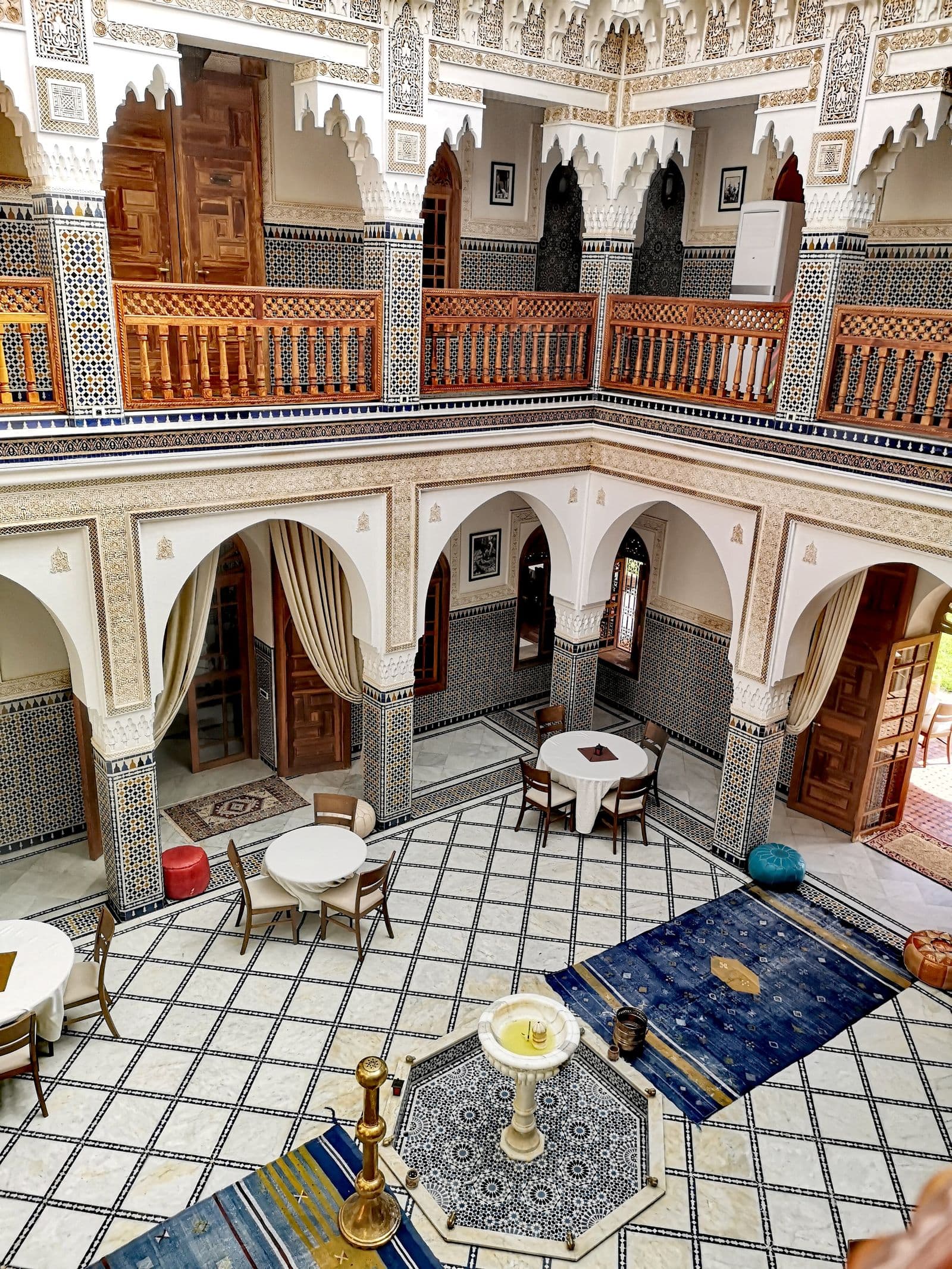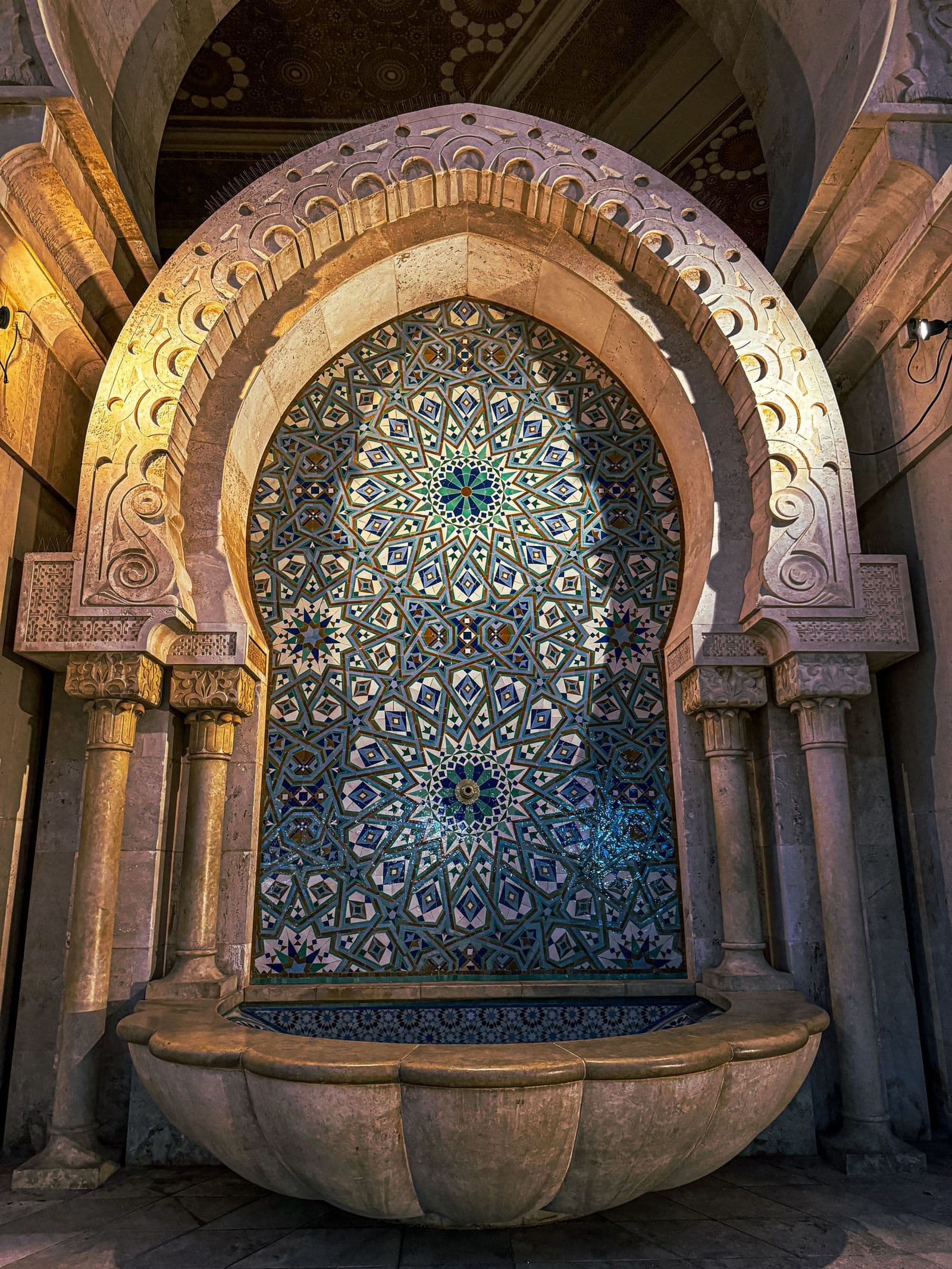
A maâlem does not work from a drawing. He sets a compass, strikes an eight-pointed star, and everything else in the panel follows from that one construction — which is why two craftsmen working three hundred kilometres apart produce panels that fit together.
The khatem
The eight-pointed star is called the khatem — Khatem Suleimani, the Seal of Solomon. Its construction is disarmingly simple: take a square, take a second identical square, rotate it forty-five degrees, and overlay them.
That is the whole rule.
Because the star is defined by a construction rather than a drawing, it is reproducible exactly, by anyone, forever. This is why the patterns have not drifted in eight hundred years.
If you solve that overlay mathematically, the ratio between the star's inner and outer radius comes out at 0.765367 — which is cos(22.5°). Every khatem in Morocco sits at that proportion, whether or not the man cutting it could tell you the number.
Stars are not enough
Here is the part that catches people out. A field of eight-pointed stars does not tessellate. Put stars alone on a wall and you get a pinwheel effect, and it looks wrong immediately.
What makes zellij zellij is the second shape: the saft, a cross-like piece that fills the interstices between four stars. Star and saft together tile the plane with no gaps and no overlaps.
Counting folds
Eight is the common fold, but not the only one:
- Eight-fold — the everyday khatem. Two squares.
- Twelve-fold — three squares at thirty degrees. Ratio 0.816497.
- Sixteen and twenty-four — reserved for the grandest panels, where the rosettes grow dense enough to read as lace.
Combine eight-point and twelve-point stars in one field and you get a layout that has appeared, essentially unchanged, in Moroccan work for eight centuries.
Why it survives
Islamic art avoids figurative imagery, and the usual explanation stops there — as though geometry were a consolation prize. It is the opposite. The patterns are a statement about unity unfolding into infinite variety: one construction, one rule, endless elaboration, no edge where it must stop.
Stand in front of a good panel in the Bou Inania madrasa and you can watch a single star become a wall.